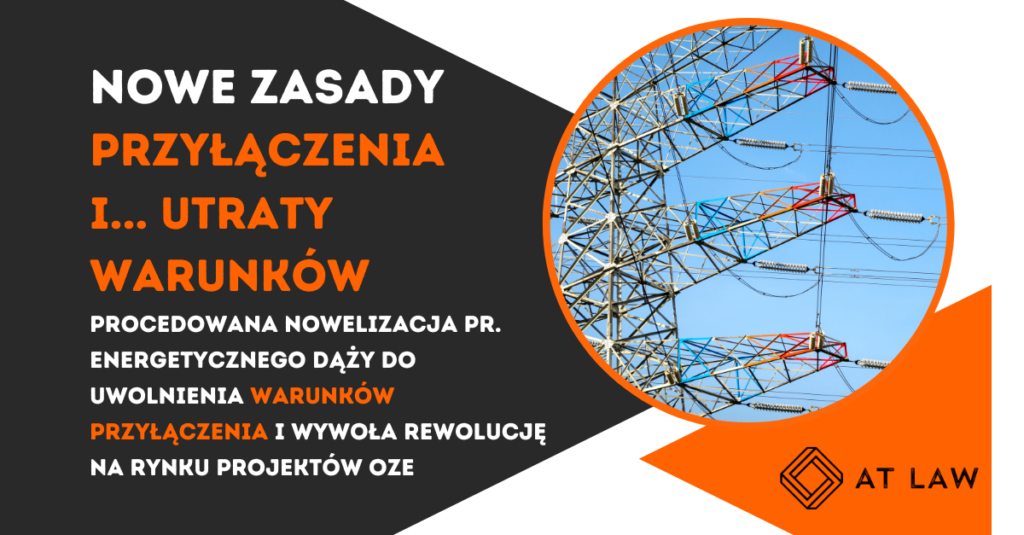
We assess the planned changes to the Energy Law Act as a revolution in the RES project market.
Planned changes to the Energy Law Act – the law firm discusses changes in the area of connection conditions
The amendment to the energy law, which is being processed under the slogan of “easing the connection conditions”, will radically change the RES market. However, not every developer of RES projects will be happy about the upcoming changes. Additional importance in the race will be the time of investment implementation and the financial resources held. Analysing the broad spectrum of the pending amendment to the Energy Law Act, AT LAW discusses the key area of grid connection conditions.
An extremely important draft amendment to the energy law (“Amendment”) has appeared on the website of the Government Legislation Centre. If the version of the act adopted by the Sejm takes into account the scope of the changes being processed, it will mean a revolution in obtaining and continuing the validity of the conditions for connection to the power grid, which is a key aspect of investment activity not only on the RES market, but in general in terms of investment planning by electricity generators and consumers.
Shortening the validity period of connection conditions
The validity period of the connection conditions would be shortened from 2 years to 1 year. As indicated in the justification to the Amendment, the change in this regard should help solve the problem of the so-called “blocking of connection capacities” and accelerate the implementation of investments.
The change in this respect does not apply to the connection conditions issued for offshore wind farms (the rules for issuing initial connection conditions and connection conditions for offshore wind farms remain unchanged) and the connection conditions issued for connection to the district heating network (still 2 years).
After analysing the transitional provisions of the amended Energy Law, the law firm concludes that they do not refer to the validity period of the connection conditions already issued, so it should be considered that the shortened deadline will apply to the connection conditions issued after the possible entry into force of the Amendment.
Higher fees, new fees.
Among the conclusions from the analysis of the Energy Law Act, which is currently being amended, the law firm indicates, among other things, an increase in the rate for the advance payment for the fee for connection to the power grid with a nominal voltage higher than 1 kV. The current rate of PLN 30 is to be replaced by a rate of PLN 60 for each kilowatt of connection capacity specified in the application for determining the connection conditions.
At the same time, the amended energy law expands the catalogue of entities obliged to pay the advance payment – from the existing energy sources and storage facilities – to: installations, equipment and networks. Therefore, it seems that the advance payment of the connection fee is to become the rule on networks higher than 1 kV, also covering, m.in, consumption installations (devices), while the Amendment explicitly excludes offshore wind farms from the scope of application of the provision.
It is also planned to increase the maximum advance payment threshold to PLN 6,000,000.
No less important role will be played by the proposed transitional provisions, which impose the obligation to supplement the advance to the new limits. This can happen in the following situations:
- if the applicant has received the connection conditions, the validity of which expires no earlier than 6 months from the date of entry into force of the Amendment, but has not concluded a network connection agreement,
- if, before the date of entry into force of the Amendment, the application for determining the connection conditions was submitted but not considered.
In such cases, the advance payment would be completed within 60 days from the date of entry into force of the Amendment. Failure to supplement the advance payment would result in significant consequences for the applicant, i.e. the loss of validity of the connection conditions or leaving the application unexamined, respectively.
As part of the significant changes to the procedure for obtaining connection conditions, resulting from the amended Energy Law Act, the law firm points to the introduction of a new fee for examining an application for determining connection conditions. This fee would be non-refundable and would amount to PLN 1 for each kilowatt of connection capacity specified in the application for determining the connection conditions, but not more than PLN 100,000.
The assumption is that this fee would apply to all devices, installations or networks (not only RES sources) connected directly to the power grid with a nominal voltage higher than 1 kV, for which an expert opinion on the impact on the power system is prepared by law. Therefore, this fee would not apply to:
- a generating unit with a total installed capacity of not more than 2 MW, or
- connected end-user equipment with a total connection capacity not exceeding 5 MW, or
- connected electricity storage with a total installed capacity of not more than 2 MW, or
- the connected generating unit of which the electricity storage facility will be a part, provided that the total installed capacity of that storage facility and generating unit is not more than 2 MW, or
- of the connected end-customer installation, of which the electricity storage facility will be a part, provided that the total installed capacity of this storage facility and the connection capacity of the end-customer’s installation is not more than 5 MW.
Similarly to the case of supplementing the advance payment, if before the date of entry into force of the Amendment the application for determining the connection conditions was submitted but was not considered, the applicant will be obliged to pay the new fee within 60 days of the entry into force of the Amendment under pain of leaving the application unexamined.
A new obligation to provide financial security at the full risk of the developer.
Analysing the planned changes to the Energy Law Act, the law firm points to a change of great financial importance for developers, concerning the introduction of an obligation for an entity applying for connection to the power grid with a rated voltage higher than 1 kV to provide security for the performance of obligations arising from the connection conditions.
The security would be paid as follows:
- in the amount of PLN 30 for each kilowatt of connection capacity specified in the application for determination of connection conditions, in the range of the value of the capacity not exceeding 100 MW, and
- in the amount of PLN 60 for each kilowatt of connection capacity specified in the application for determination of connection conditions, in the range of the value of the capacity exceeding 100 MW.
The amendment also provides for an upper limit for collateral of PLN 12,000,000.
The security can be paid in the form of a deposit or in the form of a bank or insurance guarantor. The deadline for lodging the security will be 30 days from the date of delivery of the connection conditions, otherwise they will lose their validity.
As a rule, the collateral is to be reversible (after meeting the conditions indicated in the connection agreement). However, it is worth pointing out that the security will be retained, m.in. if the applicant wants to resign from the issued connection conditions after 30 days from their delivery or refuses to conclude the connection agreement during the validity period of the connection conditions.
It is important that the transitional provisions in certain cases impose the obligation to provide security for entities that have received the connection conditions or have only submitted an application before the date of entry into force of the Amendment. The Amendment indicates the following cases:
- if the applicant has received the connection conditions, the validity of which expires no earlier than 6 months from the date of entry into force of the Amendment, but has not concluded a connection agreement – within 60 days from the date of entry into force of the Amendment,
- if an application for the determination of connection conditions was submitted before the date of entry into force of the Amendment and this application was not considered – within 30 days from the date of delivery of the connection conditions.
In the absence of a security, the connection conditions would lose their validity.
It is worth pointing out that the regulation resulting from the Amendment would also apply to offshore wind farm projects (the existing regulations in this area would be repealed).
Extended version of cable pooling
Analysing the amended energy law, the law firm emphasizes the planned extension of the cable pooling formula (the possibility of sharing a power connection) to all types of installations, including conventional and cogeneration installations. Until now, the cable pooling formula was limited only to RES sources. The proposed change is a solution that can significantly increase the efficiency of network use and improve connection power management.
Procedural issues
The amendment to the Energy Law obliges the operator to confirm the completeness of the submitted application for the issuance of connection conditions or to provide information on identified deficiencies or defects in the application. The operator will be obliged to fulfil this obligation within 60 days from the date of delivery of the application for the issuance of connection conditions. This obligation is to apply to the following applicants:
- included in the III or VI connection group – for a facility connected to the network with a voltage higher than 1 kV equipped with an electricity source or storage,
- included in the I or II connection group,
- by an entity applying for connection to the power grid of an agricultural biogas plant with a total installed electrical capacity of not more than 2 MW, meeting the conditions set out in Article 4(1) of the Act of 13 July 2023 on facilitation of the preparation and implementation of investments in the field of agricultural biogas plants, as well as their operation (Journal of Laws, item 1597).
The above change would certainly contribute to streamlining the procedure for issuing connection conditions, in particular from the point of view of investors, who currently often receive calls from operators just before the end of the deadline for issuing connection conditions.
Deadline for the request for dispute resolution by the President of the ERO
As part of the analysis of the amendment to the Energy Law Act, the law firm also identifies a procedural change, which can be called groundbreaking, namely the introduction of a deadline for the applicant to submit a request to the President of the Energy Regulatory Office for dispute resolution in the event of a refusal to conclude an agreement for connection to the power grid with a voltage higher than 1 kV for technical or economic reasons. This deadline would be 6 months from the date of delivery of the information on the refusal to determine the conditions of connection. The groundbreaking nature of this regulation results from the fact that so far such a deadline has not functioned at all, and therefore there was a fairly convenient possibility for the President of the ERO to initiate the procedure at a very distant time from the moment of the operator’s refusal to specify the connection conditions. The new regulation limits the activities of investors to a certain extent, but on the other hand, it may also contribute to increasing the dynamics of business decision-making, and ultimately to improving the functioning of the system for issuing connection conditions.
Auctions of freed connection capacities
The amendment also creates a new way of redistributing connection capacities for terminated connection contracts in the auction formula.
The subject of the auction will be the possibility of concluding a connection agreement covering the connection on the same terms as the installation covered by the contract terminated as a result of the application of the new energy law regulations described above. In particular, an auction can only be won for installations of the same type and with the same connection capacities respectively in the direction of electricity consumption or input, but without the need to maintain the same type of equipment used.
No more transparency
With regard to procedures and their transparency, the Amendment also provides:
- obliging electricity system operators to create the possibility of submitting connection applications and processing applications in a fully electronic process (with some exceptions);
- An obligation for operators to create publicly available information platforms, which would include, m.in example, information on available connection capacities, submitted applications for determining connection conditions, the status of processing the application, or rejected connection applications with the justification for the rejection.
Michał Łysakowski, Paweł Zajkowski
Partners at AT LAW Łysakowski Zajkowski Radcowie Prawni sp.p.
AT LAW – for 15 years we have been providing legal services in the field of energy law and renewable energy sources. We provide comprehensive advice on the development of RES projects, from the greenfield stage to the stage of selling energy from RES.
The above area of practice is not only energy law – the law firm advises on environmental and planning procedures, obtaining connection conditions, concessions for all types of energy projects, i.e. wind farms, photovoltaic farms, energy storage facilities, hybrid and cogeneration projects. We support clients in investment processes, due diligenceand in negotiating contracts for energy connection, transmission, distribution and trading. We undertake the analysis of innovative legal and business solutions, combining various energy generation sources and various institutions of energy law and RES, such as hybrid projects, direct lines, source aggregation, CPPA, energy clusters and cooperatives, flexibility services, virtual prosumers. For years, we have also been advising the largest RES developers on the market in Poland, as well as smaller entrepreneurs entering this market or implementing generation source projects for their own needs.
As part of the energy law practice, the law firm offers clients not only knowledge, but also experience and commitment to each case.
You can find more about the energy law practice at At LAW at this link.
Keywords:
energy law, energy law firm, energy law lawyer, energy law firm, legal advisor energy, renewable energy sources, RES, RES law firm, energy law firm, connection conditions law firm, balancing market, balancing services, flexibility services, energy aggregators, aggregation of generation sources.